 Table of Contents
- What Is 3I/ATLAS?
- A Visitor from Beyond Our Solar System
- Why Scientists Are So Excited
- What Makes 3I/ATLAS So Weird
- Could It Be Artificial?

- Natural or Not — The Debate Begins
- A Giant Cosmic Rock
- Meet Its Cousins: ʻOumuamua and Borisov
- What Happens Next?

- Why It’s So Hard to Study
- What Its Light Is Telling Us
- Where Did It Come From?
- Why These Space Visitors Matter
- What the Future Holds
- Final Thoughts

🌠 1. What Is 3I/ATLAS?
Table of Contents
Toggle3I/ATLAS is a mysterious traveler speeding through our Solar System — but here’s the twist: it didn’t come from here. It’s an interstellar object, meaning it was born around another star and somehow made its way to us.
It’s only the third known wanderer of its kind — after ʻOumuamua (2017) and Borisov (2019).
Each one is like a message in a bottle — drifting across the galaxy for millions of years before entering our cosmic neighborhood. 🌌
🌌 2. A Visitor From Beyond Our Solar System
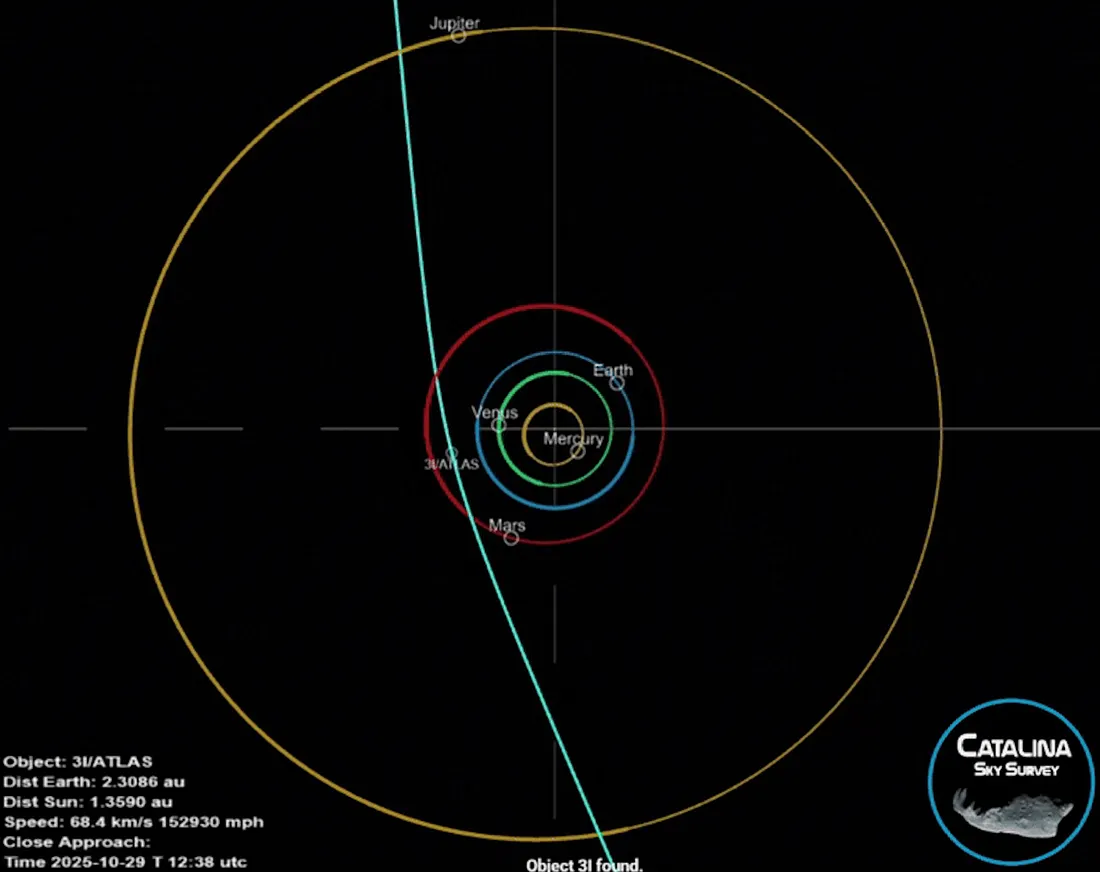
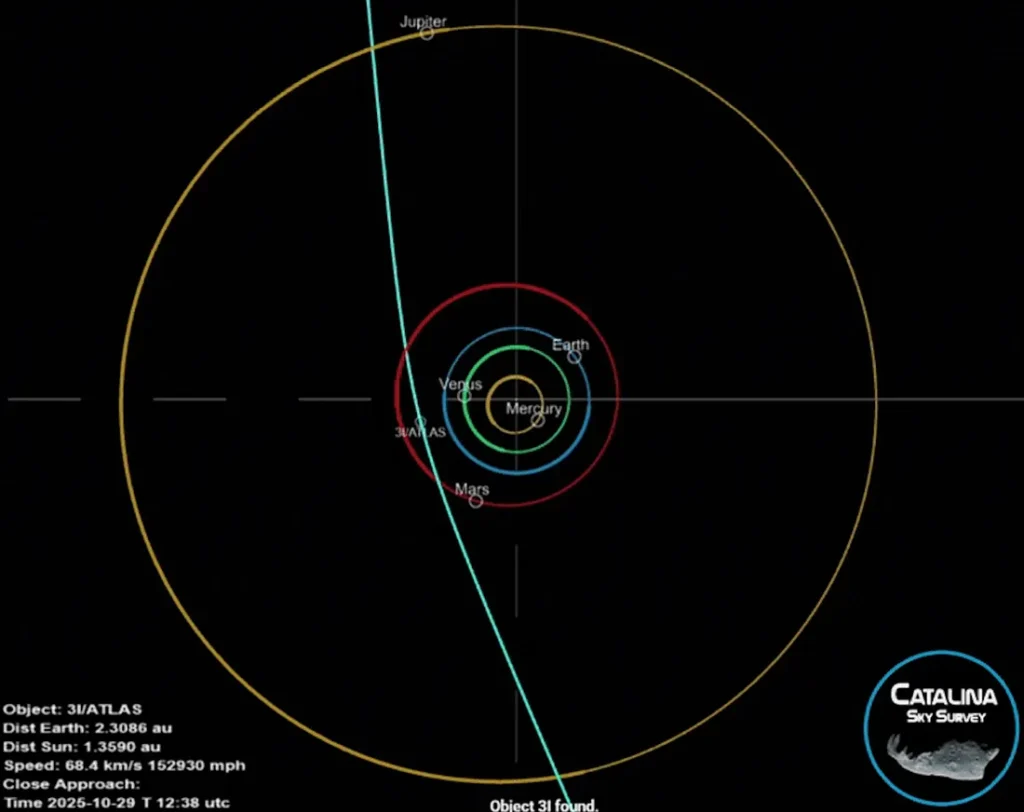
Astronomers first spotted this mysterious traveler using the ATLAS telescope in Hawaii — that’s where it gets its name. The “3I” stands for the third interstellar object humanity has ever discovered.
It’s moving at an incredible speed — so fast that even the Sun’s gravity can’t hold onto it. Once it swings past our Solar System, it’ll never return again.
A brief hello… and then goodbye forever. 🌠
💫 3. Why Scientists Are So Excited
Interstellar objects are like time capsules from other solar systems. They carry ancient dust, ice, and raw cosmic material that once orbited distant stars — revealing how other worlds are made.
Every interstellar visitor gives scientists a once-in-a-lifetime chance to study the universe’s secrets up close. 🌠
🌈 4. What Makes 3I/ATLAS So Weird
Here’s where things get really interesting: 3I/ATLAS began glowing brighter even when it was far from the Sun. Normally, comets brighten only when they move closer to the Sun — because the heat makes their icy surface vaporize. But not this one. ❄️
It’s also massive — about 5 kilometers wide, far larger than ʻOumuamua or Borisov. What’s even stranger is how its light scatters in unusual directions — a behavior scientists don’t typically see in ordinary comets.
In short: it’s glowing when it shouldn’t, and shining in ways we can’t explain yet. 🌠
👽 5. Could It Be Artificial?
Harvard scientist Avi Loeb stirred curiosity by asking a bold question:
“What if 3I/ATLAS isn’t natural?”
He doesn’t say it is alien — only that its behavior is so unusual that we shouldn’t rule out any possibilities.
This idea sparked a worldwide debate — from professional astronomers to curious space enthusiasts across the globe.
Could 3I/ATLAS truly be a natural wanderer — or a visitor with a story we’ve yet to understand? 🌠
🔭 6. Natural or Not — The Debate Begins
Most astronomers believe 3I/ATLAS is a natural comet — possibly one that formed in an extremely cold, distant star system far beyond our own. Still, many agree its strange glow and motion are unusual enough to study closely.
Some even suggest it could reveal new physics of interstellar travel — showing us how icy bodies behave in the deep, dark cold between stars.
Science thrives on curiosity — and 3I/ATLAS is keeping that spirit alive. 🌌
🪨 7. A Giant Cosmic Rock
3I/ATLAS is massive — almost 5 kilometers across. That makes it one of the biggest interstellar visitors ever seen.
It’s likely made of ancient rock and ice that formed billions of years ago around another star.
We’re literally looking at a piece of another world. 🌍✨
🌠 8. Meet Its Cosmic Cousins: ʻOumuamua, Borisov & 3I/ATLAS
Before 3I/ATLAS, two other interstellar visitors had already passed through our solar system — ʻOumuamua and 2I/Borisov. Each told a unique story about how planets and comets form in distant star systems, offering astronomers a glimpse into the mysteries beyond our Sun.
| Name | Year | Type | Size | Special Feature |
|---|---|---|---|---|
| ʻOumuamua | 2017 | Asteroid-like | ~200 m | No tail, strange motion |
| 2I/Borisov | 2019 | Comet | ~1 km | Normal comet activity |
| 3I/ATLAS | 2025 | Comet-like | ~5 km | Bright glow far from Sun |
Together, these interstellar wanderers — ʻOumuamua, Borisov, and ATLAS — help us understand how cosmic debris travels between stars. Their unique paths remind us that our solar system is part of a much larger, ever-changing galaxy.
🚀 9. What Happens Next?
Astronomers all over the world are now tracking 3I/ATLAS as it moves closer to the Sun. They’re using optical, infrared, and radio telescopes to collect as much data as possible before it disappears forever into interstellar space.
Some scientists even dream of sending a spacecraft someday to meet one of these mysterious travelers — to touch and study it up close.
Until then, every telescope on Earth is watching… as another cosmic story unfolds. 🌌
🧭 10. Why It’s So Hard to Study
The main challenge is speed. By the time we even detect an interstellar object, it’s already moving too fast and too far away for us to catch up. Planning a mission in time becomes nearly impossible — unless we’re already prepared before the next one appears.
That’s why scientists are developing ready-to-launch interceptors — spacecraft designed to wait in orbit, ready to chase the next interstellar visitor the moment it’s spotted.
The universe won’t slow down for us — so we’re learning to be faster. 🚀
🔦 11. What Its Light Is Telling Us
Every bit of light from 3I/ATLAS carries valuable information. By studying how it reflects and changes over time, scientists can decode what it’s made of — whether that’s ice, dust, or metal-rich rock.
Early observations suggest it may have come from a cold, distant region of another solar system — perhaps one that formed under very different conditions than our own.
Its faint light is like a whisper across the stars — revealing the secrets of another world. ✨
🌌 12. Where Did It Come From?
No one knows exactly where 3I/ATLAS began its long journey. It may have been ejected from its home system after a planetary collision, or flung outward by powerful gravitational forces from a massive planet.
It could have been drifting through interstellar space for millions of years, quietly traveling across the galaxy until it finally reached our Solar System.
A tiny traveler from the stars — carrying whispers of its long-lost home. ✨
🌍 13. Why These Space Visitors Matter
These interstellar visitors remind us that we’re not alone in the galaxy. Our Solar System isn’t an isolated corner of space — it’s part of a vast, dynamic cosmic network filled with roaming debris, ancient comets, and perhaps even other mysterious travelers.
Each object that passes through brings with it new clues, new questions, and fresh wonder — helping us understand not just how our Solar System formed, but how it connects to the greater universe beyond.
Every cosmic visitor is a reminder: the universe is alive with motion, mystery, and meaning. 🌌
🚀 14. What the Future Holds
Scientists are already preparing for the next interstellar visitor. Missions like the Comet Interceptor (by ESA) are being designed to launch quickly and chase these travelers the moment they’re spotted.
Next time, we might even capture close-up images or material samples from one of these visitors — offering a direct look into another solar system’s building blocks.
The next interstellar traveler could reveal secrets we’ve only dreamed of discovering. ✨
✨ 15. Final Thoughts
3I/ATLAS is more than just a wandering rock in space — it’s a reminder of how small we are and how vast the universe truly is.
Whether it’s simply a comet or something entirely new, it has already achieved something profound: it made humanity look up once again — and wonder.
“You are not alone in this cosmic ocean.” 🌌
Leave a Reply